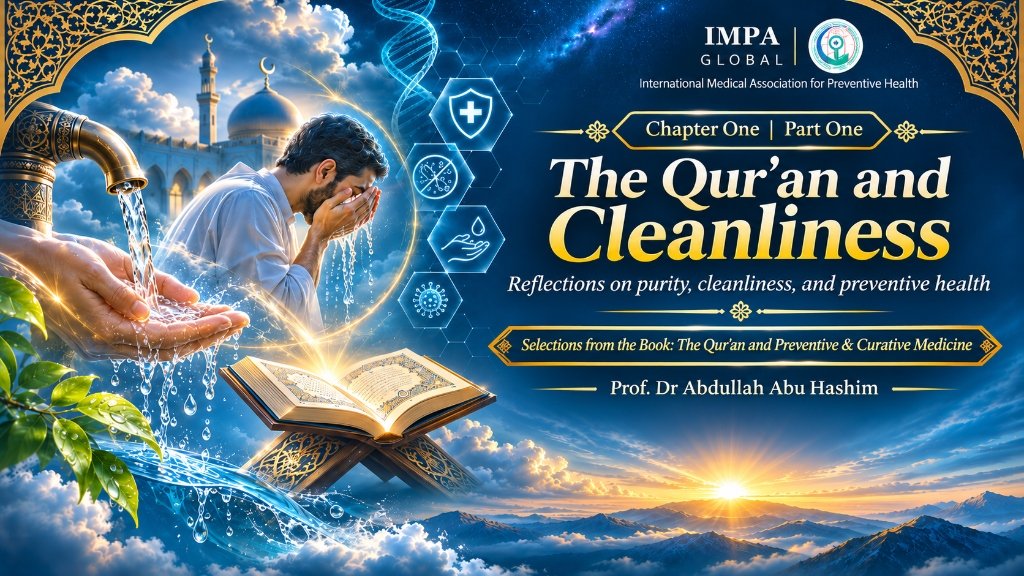
Chapter One: The Qur’an and Cleanliness
Foundational Principles of Preventive Health in the Qur’an
The Qur’an has systematically laid down the most vital foundations for integral health across the individual, family, and wider society: hygiene, nutrition, and physical exercise.
Hygiene for a Muslim is governed by a precise code that believers implement with sustained personal dedication. The Qur’an accords exceptional priority to both personal hygiene and environmental cleanliness, designating ritual purity (*Taharah*) as a prerequisite for the holiest acts of worship and a daily framework for community health.
First: Personal Hygiene — Wudu and Its Preventive & Physiological Benefits
Islam places great emphasis on two vital practices in an individual's life: Wudu (ritual ablution) and Taharah (ritual purity).
1. Wudu (Ritual Ablution): Prayer (*Salat*) and circumambulation of the Kaaba (*Tawaf*) are invalid without it. Furthermore, the consensus of jurists requires purity before touching the Holy Qur’an. It is additionally recommended as an effective remedy for anger and emotional distress, and serves to invigorate physiological and physical vitality.
What are the preventive effects and medical benefits of Wudu?
a. Prevention of Infectious Diseases: Regular ablution protects against the transmission of numerous infectious diseases spread through contaminated hands—often termed "filth-borne" and enteric infections—such as cholera, typhoid fever, food poisoning, and parasitic worms, breaking the chain of microbial transmission.
b. Stimulation of Blood Circulation and Body Vitality: Washing and massaging exposed body parts stimulates peripheral microcirculation, awakens cutaneous nerve endings, and optimizes blood perfusion toward central vital organs, providing sustained physical invigoration throughout the day.
c. Cutaneous Care and Pore Protection: Ablution clears exposed parts of accumulated grime, perspiration, and sebum, preventing sebaceous and sweat glands from clogging and preserving the skin's critical barrier and thermo-regulatory functions.
Taharah, Ghusl, and Skin Care: Scientific Precedence of Qur’anic Legislation
2. Taharah (Ritual Purity): Islam urges believers toward both outer cleanliness and inner moral purity (*Tazkiyat al-Nafs*). God's love is intimately connected with those who purify themselves: "In it are men who love to clean and to purify themselves; and Allah loves those who make themselves pure." [Surah At-Tawbah 9:108], and "Truly, Allah loves those who turn unto Him in repentance and loves those who purify themselves." [Surah Al-Baqarah 2:222].
Taharah comprises two domains: complete body wash with clean water (*Ghusl*), and the cleanliness of garments and surroundings: "And your clothing purify." [Surah Al-Muddaththir 74:4].
Ghusl (Full Ritual Bath): Obligatory following major ritual impurity (*Janabah*), menstruation, and postpartum bleeding (*Nifas*); and highly recommended for continuous personal hygiene, Friday gatherings, and Eid congregations.
Physiological and Health Benefits of Ghusl:
1. Revitalizes the organism and stimulates bodily vigor by activating cutaneous neural endings across the entire body surface.
2. Relieves vascular congestion in the skin and pelvic organs, redirecting blood circulation toward vital inner organs, notably the brain and myocardium, thereby restoring systemic hemodynamic equilibrium.
3. Constitutes a balanced neuromuscular exercise that relieves tension, reduces systemic fatigue, and restores autonomic balance.
Dermatological Care and Scientific Precedence: Here we witness the profound scientific foresight of the Qur’an and Sunnah in prescribing Wudu and Ghusl when contrasted with modern dermatology. Contemporary science emphasizes regular washing, particularly of exposed regions, to keep sweat and sebaceous pores clear and prevent microbial colonization. Islam mandates washing exposed areas multiple times daily and washing flexural areas regularly, achieving optimal dermatological hygiene.
The Sunan al-Fitrah: A Comprehensive Bodily Hygiene System
The Sunan al-Fitrah (Practices of Natural Disposition): These are hygienic habits and healthy personal traits encouraged by Islam, forming an essential component of spiritual and physical purification.
They integrate seamlessly with the Islamic philosophy of holistic cleanliness, elevating self-care into an act of sustained devotion.
Among the primary Sunan al-Fitrah specified by the Prophet ﷺ for bodily preservation are:
• Trimming the nails: To prevent the accumulation of pathogens, bacterial flora, dirt, and parasitic ova underneath them.
• Trimming the moustache: To preserve oral hygiene, avoid food and drink contamination, and maintain a dignified appearance.
• Plucking armpit hair and shaving pubic hair (Istihdad): To maintain hygiene in flexural areas of high sweating, preventing anaerobic bacterial fermentation that produces malodor and folliculitis.
• Using the Siwak (Natural Tooth-Stick): For oral disinfection and periodontal care; it is "a purifier for the mouth and pleasing to the Lord", providing natural antibacterial compounds, fluoride, and anti-plaque fibers.
• Rinsing mouth and nose (Madmadah & Istinshaq): Cleansing the oral and nasal cavities from dust, microbes, and mucosal crusting, protecting the upper respiratory tract.
• Washing the finger joints (Ghasl al-Barajim): Cleansing the creases, knuckles, and skin folds of the fingers where grime and moisture typically gather.
• Circumcision and Istinja (Cleansing with water): Achieving complete post-excretory cleanliness and protecting against urinary tract infections and preputial microbial accumulation.
The Five Pillars of Sunan al-Fitrah in Islamic Medicine
The relationship between the Sunan al-Fitrah and preventive medicine manifests through five essential dimensions:
1. Cleanliness as Worship: Islam establishes hygiene as an indispensable part of faith: "Purity is half of faith" [Sahih Muslim].
2. Medical Prevention: Clinical research confirms that adhering to these practices—such as circumcision, nail hygiene, Siwak, and Istinja—guards against a broad spectrum of urogenital infections, dental caries, periodontal pathology, and chronic inflammatory dermatoses.
3. Psychological and Social Well-being: Personal cleanliness and fresh breath bestow self-confidence, psychological peace, and pleasant social interaction during congregational prayers and daily engagements.
4. Structured Temporal Discipline: Islam did not leave personal hygiene to haphazard inclination; it instituted a defined timeline (not exceeding forty days for nail and hair maintenance) to guarantee continuous habituation.
5. Aesthetic Dignity: The practices ensure the eradication of bodily nuisance, presenting the believer in a refined state that honors human dignity.
In Summary: The Sunan al-Fitrah constitute an integrated personal hygiene code harmonizing somatic cleanliness with spiritual elevation, affirming that Islam is the religion of purity in every aspect.
Second: Environmental Cleanliness, Public Health & Water Safety
Islamic hygienic guidance extends beyond individual physiology to establish comprehensive environmental safeguards and public health protection:
1. Protection of Water Reservoirs: The Messenger of Allah ﷺ said: "None of you should urinate in stagnant water and then wash in it." [Sahih al-Bukhari & Muslim]. This miraculous prophetic injunction is recognized by epidemiology as one of the most effective preventive measures to interrupt the transmission cycle of Schistosomiasis (Bilharzia) and other lethal water-borne epidemics.
2. Prohibition of Public Contamination (The Three Cursed Acts): The Prophet ﷺ strictly forbade urinating or defecating in water sources, shaded gathering spots, and public thoroughfares, designating them "the three acts that provoke curses" because they spread contamination, pathogens, and public distress.
Modern public health affirms that improper sewage and waste disposal constitutes the primary etiology for epidemic dissemination, soil contamination, and vector proliferation.
Prophetic Preventive Applications: Food Safety, Quarantine, and Hazard Removal
The Prophetic Sunnah embodies a robust paradigm of proactive preventive interventions:
3. Hand Hygiene Upon Waking: The Prophet ﷺ said: "When one of you wakes up from sleep, let him not dip his hand into the vessel until he has washed it three times, for he does not know where his hand spent the night." This represents an advanced microbiological precaution against cross-contamination.
4. Covering Food and Water Vessels: The Prophet ﷺ instructed that food and drink containers be covered and water skins tied, preventing exposure to airborne dust, flies, and insect vectors.
5. Hygienic Handling of Food: He ﷺ advised that if a morsel falls to the ground, one should remove any surface dirt and not discard nutritious food carelessly.
6. Epidemiological Quarantine and Physical Isolation: The Prophet ﷺ formulated the earliest principles of strict quarantine during epidemics: "If you hear of a plague in a land, do not enter it; and if it occurs in a land while you are in it, do not leave it." [Muttafaq ‘alayh]. He further stated: "Flee from the leper as you would flee from a lion," and "No infected person should be brought to a healthy one." These directives constitute the very foundation of modern social distancing, isolation protocols, and biosecurity measures applied during global outbreaks such as COVID-19 and cholera.
7. Sanctity of Public Health: The Qur’an prohibits inflicting harm on people or exposing them to pollution: "And those who harm believing men and believing women for [something] they have not earned have certainly borne upon themselves a slander and manifest sin." [Surah Al-Ahzab 33:58].
8. Eradication of Insalubrious Habits: The Prophet ﷺ forbade spitting in public spaces, designating it a violation requiring remediation, in direct anticipation of airborne pathogen transmission such as pulmonary tuberculosis.
9. Removing Harmful Obstacles as an Act of Faith: He ﷺ declared: "Whoever mentions the name of Allah and removes a stone, a thorn, or a bone from people's paths walks having distanced himself from the Fire," and "Removing harm from the path is a branch of faith."
Authoritative Reference: Prof. Dr Abdullah Abu Hashim, The Qur’an and Preventive & Curative Medicine, Chapter One: "The Qur’an and Cleanliness" (pp. 8–23). Text verified and reviewed for Qur’anic, Hadith, and clinical fidelity under the editorial supervision of the International Medical Professions Association (IMPA).